

Car Diffuser Bottles vs Reed Diffuser Bottles: Structure and Accessory Differences
Compare car diffuser bottles and reed diffuser bottles by neck design, plugs, caps, cords, reeds, leakage risk, carton packing and sample checks.

Diffuser bottles serve different fragrance systems. A car diffuser is a compact assembly that may hang, tilt, warm up and move during use. A reed diffuser is a stationary room-fragrance pack that must hold more liquid, accept reeds and look balanced on a shelf. Purchasing teams should compare the two by use direction, neck structure, capacity, sealing, evaporation route, shipping risk, decoration and accessory packing.
The direct answer is that car diffuser bottles suit small mobile fragrance products, while reed diffuser bottles suit room-fragrance displays. The same supplier may offer both, but the approval checklist should not be the same. A small car diffuser can fail because a plug loosens under movement. A reed diffuser can fail because the neck, plug, cap, fill level and carton do not work together during shipment.
Use direction changes the bottle design
A car diffuser bottle may hang from a mirror, clip to a vent, sit in a small holder or ship as a refill accessory. It faces movement, orientation changes and possible heat exposure. The bottle is usually small, so the cap, plug, cord, vent clip or wick structure plays a large role in performance.
A reed diffuser bottle is normally opened and placed on a flat surface. It must support reeds, remain stable, show enough liquid, and match home-fragrance branding. After opening, the key variables are reed count, reed diameter, neck opening, liquid level, room airflow and formula behavior. A supplier should not promise a fixed fragrance life without formula and use-condition evidence.
Structure comparison
| Decision area | Car diffuser bottle | Reed diffuser bottle |
|---|---|---|
| Use position | Hanging, vent-mounted or compact accessory | Stationary shelf or tabletop display |
| Capacity logic | Small volume, short-distance fragrance release | Larger volume tied to room-fragrance program |
| Neck structure | Plug, cap, cord, vent accessory or wick route | Plug, stopper, cap and opening for reeds |
| Sealing risk | Motion, tilt, heat and small-part fit | Filled-bottle leakage, plug creep and carton pressure |
| Decoration space | Small label, cap color, cord and gift card | Larger label, coating, cap and box presentation |
| Accessory pack | Cord, clip, plug, stopper or refill cap | Reeds, plug, cap, collar, box and insert |
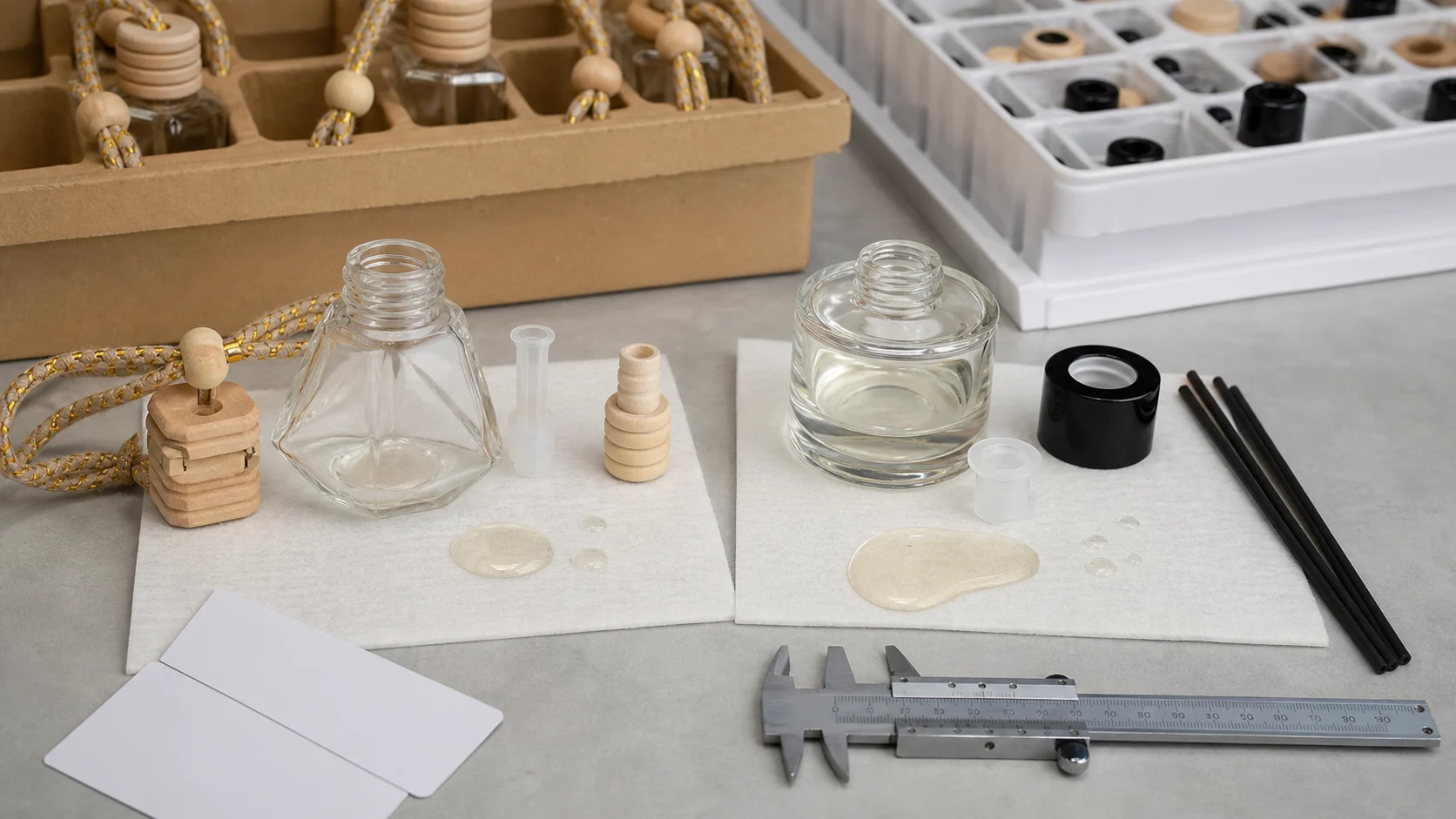
When car diffuser bottles fit the project
A Car hanging diffuser bottle is suitable when the product is meant to be compact, mobile and close to the user. They work best when the brand can express itself through a small bottle shape, cap color, cord, hang tag or compact gift pack. They are less suitable when the formula needs a large liquid volume, a broad display face or a long stationary evaporation program.
Purchasing teams should pay attention to plug fit, cap security, cord attachment, vent accessory strength and whether the bottle may be tilted during use. If the product ships filled, the sealed assembly should be checked in the orientation and packing route that the supplier expects. If it ships empty as a refill bottle, the consumer assembly instructions become more important.
When reed diffuser bottles fit the project
A Square diffuser bottle route is suitable when shelf presence, room-fragrance duration and home-decor appearance matter. The bottle should look stable with reeds installed, and the neck opening should match reed count and diameter. A narrow opening may look elegant but can make filling, plugging or reed insertion harder. A wide opening may support reeds better but needs a cap or plug route that controls leakage during shipping.
Reed diffuser bottles are less suitable when the product must move with the user or fit into a small vehicle accessory pack. They usually need more carton space and more protection for filled-liquid transport, especially when reeds, caps and decorative collars are included.
Sealing and shipping differences
Car diffuser leakage often comes from motion, plug fit, cap security or heat exposure. Reed diffuser leakage often comes from filled-bottle pressure, plug creep, cap pressure, headspace, carton movement or fragrance contact with closure materials. Purchasing teams should not approve either product from an empty decorative sample alone.
Ask for assembled and packed samples. For car diffusers, review the bottle with cord, cap, plug or vent accessory. For reed diffusers, review the filled bottle with plug, cap, reeds, carton and insert. If the formula is confidential, the buyer can still define whether the supplier is testing with a representative liquid and what that test does not prove.
Evaporation and capacity
Capacity should be chosen around use pattern. A car diffuser uses smaller volume because the product is close to the user and space is limited. A reed diffuser uses more volume because it is intended to release fragrance into a room. The purchase specification should describe the intended fill level and accessory system, not only the bottle's nominal capacity.
Fragrance release depends on formula, wick or reed material, reed count, reed diameter, airflow, temperature and consumer use. A credible RFQ asks for compatibility and sample evidence rather than fixed duration claims. This protects the buyer from turning a design preference into a performance promise.
Decoration and accessory trade-offs
Car diffusers have limited decoration space. Simple logos, colored caps, cords, small labels and hang cards often work better than complex artwork. Fine text may be hard to read on a tiny curved bottle. Reed diffusers have more room for labels, coating, printing, wooden caps or decorative collars, but those finishes must still survive fragrance contact and carton movement.
Accessories change cost and approval work. A car diffuser may need a plug, cord, vent clip, refill cap or protective inner tray. A reed diffuser may need reeds, plug, cap, collar, box and insert. Quotes should show which accessories are included and which sample checks are included.
Buyer decision table
| Project condition | Better starting route | Reason |
|---|---|---|
| Mobile fragrance accessory | Car diffuser bottle | Small assembly, motion use and compact pack |
| Home fragrance display | Reed diffuser bottle | Stable shelf presence and reed-based release |
| Large label or premium coating | Reed diffuser bottle | More decoration area and stronger retail presence |
| Small gift or promotional pack | Car diffuser bottle | Lower volume and accessory-led branding |
| Filled export shipment | Either, with packed-sample approval | Leakage risk depends on assembly and carton route |
RFQ details to send
For car diffuser bottles, send fill volume, bottle shape, neck finish, plug or cap type, cord or vent accessory, use orientation, decoration method, packing method and sample requirement. For reed diffuser bottles, send capacity, fill level, neck opening, plug or stopper, cap, reed length and diameter, carton or gift-box route and shipping destination.
Project fit and not-fit examples
A car diffuser bottle fits projects that need a compact fragrance accessory, a small gift item, a branded vehicle product or a low-volume promotional fragrance pack. It is less suitable when the buyer needs a large label, a long fragrance-release message, a heavy premium bottle or a display object for home décor. The small format leaves less room for information, so the hang tag, carton or insert may need to carry instructions.
A reed diffuser bottle fits home fragrance, gift sets, spa products and retail shelves where the bottle remains visible during use. It is less suitable for mobile use, tight accessory packs or projects where spill risk from open reeds cannot be managed. If the buyer needs both car and room fragrance in one brand family, it is usually better to design two related packs rather than force one bottle to serve both use cases.
Sample approval differences
Car diffuser samples should be reviewed as small assemblies. Check plug tightness, cord strength, vent clip or hanging method, cap fit, fill level, label readability and packed orientation. Because the bottle is handled and moved more often, buyer approval should focus on assembly security and leakage risk during motion.
Reed diffuser samples should be reviewed with the bottle, plug, cap or collar, reeds, fill level and carton. Check whether the plug can be removed cleanly, whether the cap protects the filled bottle during shipment, whether the reeds fit the carton, and whether the filled bottle remains stable on a shelf. These checks are different from car diffuser checks because the finished product is displayed in one place and interacts with reeds over time.
Range strategy for fragrance brands
Brands that sell both formats should connect the packs visually without making them structurally identical. Shared cap colors, label language, carton graphics or glass color can create a family look. The bottle structure should still follow the use case: compact and secure for car diffusers, stable and reed-compatible for room diffusers.
This approach keeps the brand recognizable while letting each product perform in its own environment. It also makes supplier comparison easier because the buyer can quote two correct assemblies instead of asking one bottle to solve two different fragrance systems.
A practical next step is to choose by use system first. Once the system is clear, bottle shape, accessory fit, decoration and packing decisions become easier to compare across suppliers.
 Scan WhatsApp
+86 173 6846 7899