

When to Choose Amber Glass Bottles for Oils, Serums and Sensitive Formulas
A formula-led method for choosing amber glass, clear glass or secondary light protection for essential oils, facial oils and active serums.

Choose amber glass when the formula has a demonstrated light-sensitivity risk and the bottle must provide protection during normal storage and use. Choose clear glass when product visibility is commercially important and stability work shows that the marketed pack—possibly including an opaque label or carton—still protects the formula. For amber glass dropper bottles, colour is only one part of the decision: wall thickness, closure fit, oxygen entry during dispensing, headspace, decoration and secondary packaging all affect the finished system.
A quick decision matrix for oils and serums
| Product condition | Starting packaging route | What must be verified |
|---|---|---|
| Formula shows light-driven colour, odour or assay change | Amber glass, with an opaque carton if exposure is severe | Spectral transmission of the actual bottle and stability in the complete marketed pack |
| Stable oil or serum whose colour supports the brand story | Clear glass may be suitable | Real-time and accelerated stability with the final label, closure and distribution conditions |
| Light-sensitive formula that is also oxygen-sensitive | Amber glass is useful, but an airless or low-exposure dispenser may be the stronger system | Oxygen exposure, dose repeatability, closure compatibility and formula recovery |
| Short-use professional product kept inside a carton | Clear or amber glass can be evaluated | Whether the carton remains with the product through use and whether instructions support that behaviour |
| Formula risk is unknown | Do not choose by aesthetics alone | Side-by-side screening followed by stability testing in candidate packs |
This matrix is a starting point, not a substitute for formula-specific evidence. When evaluating a container-closure system, review protection, compatibility, safety and performance, then confirm the finished pack with formula-specific stability testing. That principle is useful beyond pharmaceuticals: the bottle supplier can document glass and dimensions, but the brand or filler must confirm how the complete pack performs with its own formula.
What amber glass does—and what it does not do
Amber colour reduces transmission in portions of the ultraviolet and visible spectrum that can drive photochemical change. That is why established packaging suppliers position amber Boston rounds for essential oils, herbal extracts and tinctures, while clear glass is commonly offered where product visibility is the priority. However, “amber” is not a universal performance grade. Furnace colour, glass composition, container geometry and local wall thickness can change the optical result.
The European Pharmacopoeia's recent work on coloured pharmaceutical glass is especially relevant to buyers: EDQM explains that the light transmission of coloured glass depends on container wall thickness, and its revised approach bases spectral-transmission specifications on wall thickness rather than only volume and closure format. A colour chip, catalogue photo or supplier statement that a bottle is “UV protective” therefore does not establish the performance of every bottle shape. Ask for test data or a specification tied to the actual container, production standard and relevant wavelength range.
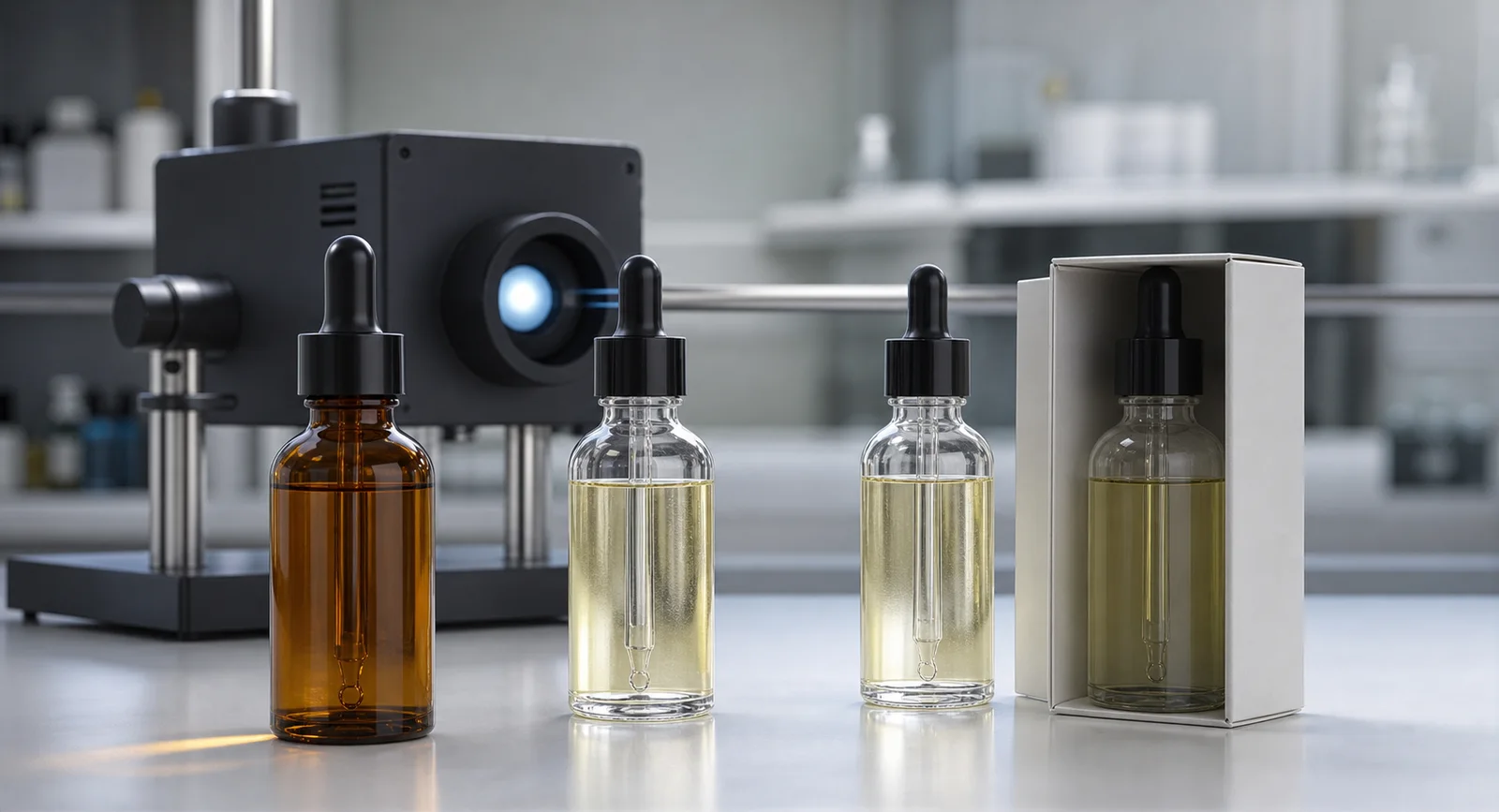
Amber glass also does not stop oxygen entering through a dispensing system. A dropper is opened repeatedly and its rubber bulb, cap, pipette and wiper or neck interface become part of the compatibility question. Glass is an effective barrier through the bottle wall, but a poor seal can still allow leakage, solvent loss or gas exchange. This is why an amber essential oil dropper bottle should be approved as a bottle-and-closure assembly, not as an empty glass component.
Apply the decision differently by formula type
Essential oils and aromatic blends
Amber glass bottles for essential oils are a sensible default when the blend's light sensitivity is known or when the product may sit on an open shelf. Yet light is not the only ageing mechanism. Oxygen, heat, fill headspace and repeated opening can change aromatic materials. The purchase specification should therefore pair the glass-colour decision with the chosen reducer, cap or dropper, fill volume and storage claim. For small retail packs, compare an amber bottle with the exact closure against any clear premium option rather than extrapolating from glass colour alone.
Facial oils and oil-based serums
Brown dropper bottles—an informal search term for amber containers—can support natural or apothecary positioning and reduce light exposure. But a peer-reviewed olive-oil study provides a useful caution for oil products generally: under direct sunlight, amber glass reduced deterioration compared with clear glass but did not prevent it, while an opaque covering provided stronger protection in that experiment. The result should not be transferred into a cosmetic shelf-life claim, but it does show why an outer carton, storage instructions and exposure conditions deserve consideration when the formula is sensitive.
Water-based serums with sensitive actives
For amber serum bottles, the key question is whether light protection is the dominant need. Packaging suppliers often recommend amber, cobalt, opaque or coated glass for light-sensitive actives, but an airless dispenser when repeated oxygen exposure is the larger concern. Clear glass may still be viable for a stable formula or when a full-coverage label and carton form part of the protective system. If light protection is required, a clear or translucent container may need an opaque covering or secondary package that remains in place during use.
Pharmaceutical, diagnostic or regulated applications
Do not treat cosmetic-style amber bottles and compendial pharmaceutical containers as interchangeable. Regulated projects may need a defined glass type, hydrolytic-resistance evidence, spectral-transmission compliance, traceability and a qualified closure system. Obtain the applicable specification and test method from the quality team before requesting a commercial quote. A visual colour match cannot replace those requirements.
Amber glass versus other protection strategies
| Strategy | Strength | Limitation | Best procurement question |
|---|---|---|---|
| Amber glass | Built-in light filtering that remains with the bottle | Performance varies with the actual glass and wall; formula remains visible only partly | What spectral-transmission evidence applies to this exact bottle? |
| Clear glass plus opaque carton | Combines shelf presentation when unboxed with strong protection while boxed | Protection falls if the carton is discarded during use | Will stability and use testing reflect the time the bottle spends outside the carton? |
| Opaque or UV-control coating | Wide colour freedom and potentially high coverage | Adds adhesion, abrasion, colour-tolerance and migration/compatibility questions | Which durability and formula-contact risks are tested after decoration? |
| Full-coverage pressure-sensitive label | Efficient branding and partial light barrier | Seams, base, shoulder and uncovered areas may still transmit light | Has the decorated production bottle been measured rather than the label material alone? |
| Airless dispenser | Can reduce repeated air exposure and control dosing | Not every formula, viscosity or premium-glass brief fits the system | Is oxygen exposure more damaging than light for this formulation? |
A six-step qualification method for buyers
- Define the failure mode. Ask the formulator what changes under light, oxygen and heat: colour, odour, viscosity, pH, assay, peroxide value or another validated attribute. Do not assume every botanical or active fails in the same way.
- Shortlist complete systems. Compare amber glass, clear glass with its final decoration and carton, and an alternative dispenser if oxidation is material. Use the same nominal fill and intended closure across samples where possible.
- Verify the container. Request drawings, overflow and recommended fill capacity, glass specification, wall-distribution controls, neck finish, and any spectral-transmission report applicable to the actual stock or custom bottle.
- Test the closure and formula contact. Confirm cap or dropper fit, pipette length, liner or wiper, application and removal torque, leakage orientation, bulb and elastomer compatibility, and dose performance after ageing.
- Run stability in the marketed pack. Include the final decoration, closure, fill level and secondary packaging. For cosmetics, sunlight, air and temperature can affect color, texture and smell; shelf life should be established for the specific formula and finished package.
- Lock the approval standard. Keep approved colour boundaries, dimensional criteria, closure references, packaging configuration and change-control requirements with the purchase specification.
Common sourcing mistakes
- Buying by colour name: “dark amber” is a visual description unless a measurable optical requirement accompanies it.
- Testing a bare bottle: decoration, fill level, closure and carton can change the final protection and user behaviour.
- Ignoring wall distribution: the base may look dark while thinner panels or shoulders transmit more light.
- Assuming amber solves oxidation: colour does not correct an incompatible bulb, weak seal, excessive headspace or repeated air exchange.
- Borrowing another formula's shelf life: packaging guidance and supplier data support selection, but only the brand's stability programme substantiates its finished-product claim.
RFQ checklist for amber glass dropper bottles
- Formula category and known sensitivity to light, oxygen and temperature
- Nominal fill, overflow capacity and acceptable headspace
- Required amber appearance plus any spectral-transmission or compendial requirement
- Bottle drawing, neck finish and compatible dropper or cap reference
- Pipette material and length, bulb/elastomer material, liner or wiper, and dose target
- Final label, coating, printing and carton configuration used in stability work
- Leak, torque, dispensing, decoration-durability and transport test expectations
- Approved sample route, traceability documents and change-notification requirement
Decision rule: choose amber glass when evidence shows that reducing light exposure materially improves the formula's stability and the actual bottle meets the required optical performance. Choose clear glass only when visibility brings real value and the complete pack passes stability with its decoration and secondary protection. If oxygen exposure is the larger risk, evaluate the dispensing system before treating amber colour as the main solution.
 Scan WhatsApp
+86 173 6846 7899
Scan WhatsApp
+86 173 6846 7899