

Public Mold Bottles vs Private Mold Bottles: A Practical Buying Decision
Compare public mold and private mold glass bottles by speed, cost, exclusivity, testing risk, decoration fit, reorder control and sample approval.

Public mold bottles are usually the safer starting point when buyers need speed, known dimensions, lower development cost and a proven component route. Private mold bottles become worthwhile when an existing shape cannot solve the brand, fit, filling-line, carton-footprint or exclusivity requirement, and when the buyer has enough validation and reorder confidence to support tooling and sampling work.
In practical sourcing, the decision is not a simple choice between a “good” public mold and a “premium” private mold. It is a sourcing-risk decision. A public mold reduces development variables but limits shape ownership. A private mold can create a stronger brand asset or technical fit, but it adds drawings, sample stages, revisions, closure matching, packing checks and change control.
Public molds and private molds: the practical difference
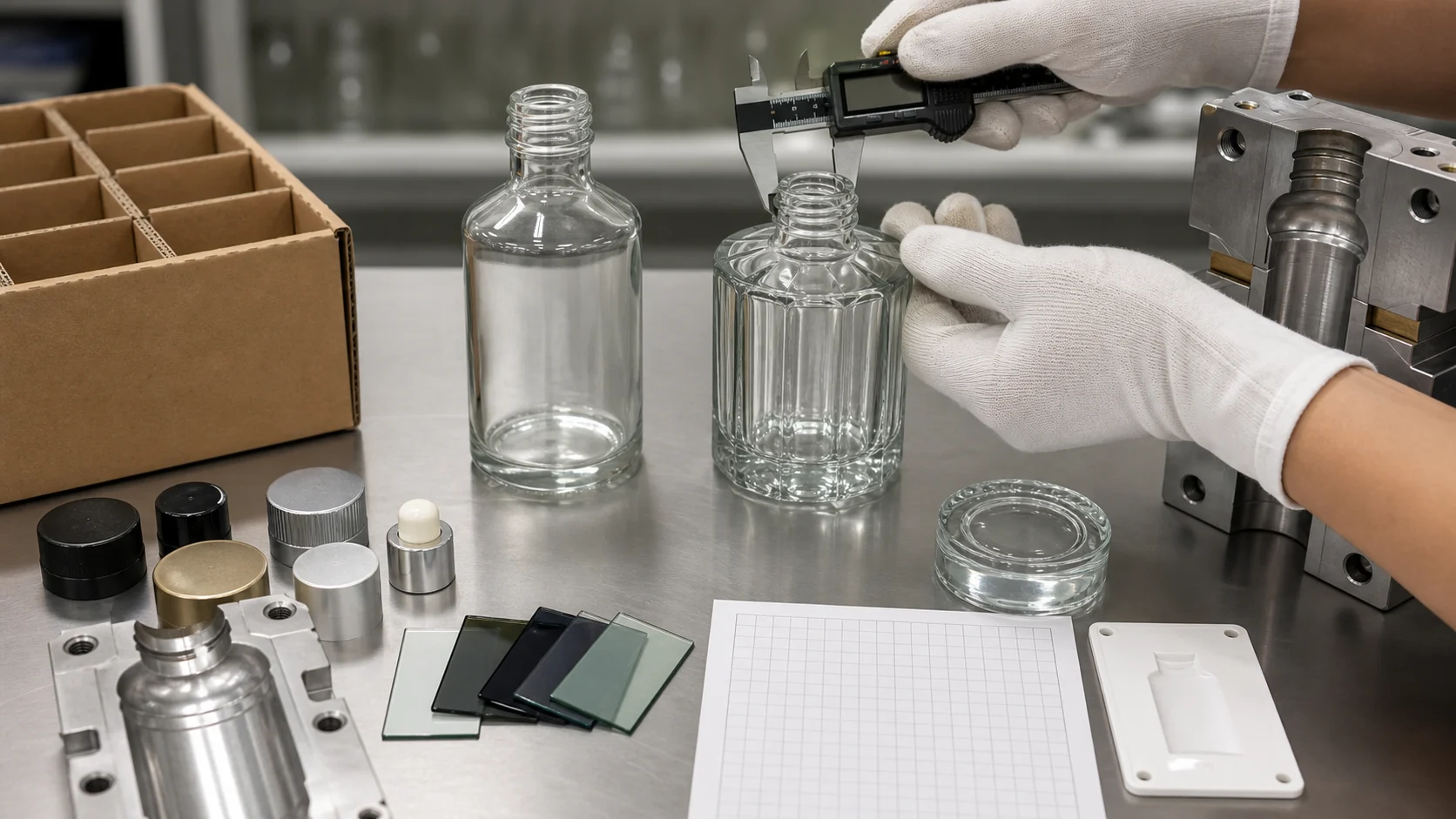
For Perfume bottles, a public mold is an existing bottle shape that a supplier can offer to multiple buyers. It may already have known capacity, neck finish, closure options and carton experience. Buyers can often see samples faster and compare decoration routes without waiting for a new bottle structure to be developed.
A private mold is a project-specific bottle shape or structural change made for a buyer's product. It may involve a new silhouette, shoulder, base, embossing, grip area, capacity, neck detail or carton footprint. The buyer gains more control, but the project becomes a development process rather than a simple purchase.
When a public mold is the lower-risk choice
Public molds are the lower-risk choice for market tests, first launches, seasonal products, tight timelines and projects where decoration can create enough differentiation. A stock bottle with a strong label, coating, cap, pump, carton or secondary pack may deliver the brand effect without tooling exposure.
They are also useful when closure compatibility matters more than shape ownership. If a supplier already knows which cap, pump, dropper or stopper fits the bottle, the buyer can focus on sample approval, decoration and packing rather than proving a new structure from the beginning.
When a Private Mold Becomes Worthwhile
A private mold becomes more reasonable when the buyer can state a clear reason that a public mold cannot solve. That reason may be shelf differentiation, a signature base, a unique shoulder, a better grip, a specific closure fit, a filling-line need, an embossing requirement or a carton footprint that improves packing efficiency.
The reason should connect to commercial value. If the new shape helps the brand win shelf recognition, justify a premium price, improve use, protect a design system or support repeat orders, private tooling may be worth evaluating. If the only reason is that the team wants something different, decoration or a better public mold may be a smarter first route.
Private mold work is easier to justify after the product concept has evidence behind it. Evidence may include confirmed channel demand, retailer feedback, repeat purchase expectations, margin room or a product family that can use the same shape over time. Without this validation, tooling work can lock the buyer into a bottle before the market has proven the offer.
Reorder forecasts matter because tooling and sampling effort are recovered over time. A one-time order with uncertain demand usually favors a public mold. A repeat program with stable volume, strong margin and long-term brand use may support private mold development.
Before paying for a private mold, compare the new shape against the best available public mold route. If a public mold can achieve the same shelf effect with decoration, closure choice and carton design, the private mold needs a stronger reason. If the private mold improves brand recognition, hand feel, closure fit, line handling, carton efficiency or family consistency, the business case becomes clearer.
The worth test should include risk. A unique shape may require more sample rounds, longer approval time and tighter reorder control. It may also make replacement sourcing harder if the original supplier cannot meet future demand. Purchasing teams should decide whether exclusivity, function or brand value offsets those risks.
Closure fit, filling line and carton footprint
Shape decisions affect more than appearance. A new neck or shoulder can change pump seating, cap clearance, dropper length, label panel, filling-line handling and overcap height. A heavier base can change carton weight and freight. A wider shoulder may need a different divider or gift-box insert.
Before approving private mold work for Cosmetic bottles, check the full assembly: bottle, closure, label or decoration, carton and filling route. If the product must run through a specific filler, the filling line should be considered early. A bottle that looks distinctive but does not fit the closure, carton or line can create expensive late revisions.
Sample Stages and Change Control
Design & Development review helps public mold projects move through product sample, decoration sample, packed sample and final approval. Private mold projects add more stages: drawing review, prototype or sample mold, first trial, revisions, assembly check, decoration sample, packed sample and production approval. Each stage can reveal issues that were not visible in the design file.
Purchasing teams should decide what is locked at each stage. Capacity, overflow capacity, glass weight, neck finish, closure fit, embossing depth, label panel, base detail and carton fit all need clear approval points. Late changes can reopen cost and timing, so the approval record should name which changes require review before mass production.
Change control protects both routes. For public molds, changes may include cap model, pump supplier, decoration process, carton divider or label material. For private molds, changes may include drawing revisions, neck finish, base weight, embossing, shoulder radius or mold stage. Any change that affects fit, appearance, packing or inspection should trigger sample review.
A clear change record should state the approved sample date, drawing version, closure model, decoration route, carton specification and accepted visual boundaries. This record becomes especially important for reorders, when a similar-looking substitution can change the functional result.
Decision matrix for buyers
| Project condition | Better starting route | Why |
|---|---|---|
| Fast launch or low-risk market test | Public mold | Known shape, faster samples and fewer unknowns |
| Standard closure and normal carton route | Public mold | Existing component matching can reduce approval work |
| Brand shape must be ownable | Private mold | The bottle silhouette is part of the product value |
| Special closure, grip or fill-line need | Private mold | Functional requirements may not fit stock shapes |
| Uncertain reorder demand | Public mold first | Avoids tooling exposure before validation |
| Repeat program with margin and volume | Private mold may be justified | Development effort can support a long-term packaging asset |
Cost drivers beyond the mold itself
The tooling quote is only one cost line. Purchasing teams should also consider design work, technical drawings, prototype review, sample mold or first-trial cost, revision time, closure matching, decoration trials, carton changes, inspection records and possible launch delay. A low tooling quote can still be expensive if it excludes the work needed to make the bottle repeatable.
Public molds have hidden costs too. The buyer may need decoration samples, closure samples, carton redesign, label adaptation or a different cap to make the stock bottle fit the brand. The right comparison includes all work required to launch the finished pack, not only the empty bottle price.
RFQ information to include
A public mold RFQ should include product category, target capacity, preferred shape, closure route, decoration need, order quantity, packing route, sample deadline and whether existing accessories are required. Ask which components and cartons have been used with the bottle before.
A private mold RFQ should add design drawings or references, target capacity, overflow capacity if known, glass weight expectation, neck finish, closure model, embossing or texture requirements, decoration area, filling-line constraints, carton footprint and reorder expectation. Ask which development stages are included in the quote and which revisions would create extra cost or time.
Comparing Supplier Offers and Negotiation Points
Two suppliers may quote the same idea differently. One may include drawing work, sample revisions and closure matching. Another may quote only the basic mold cost. Compare what is included: design support, drawings, sample mold, production trial, glass-weight target, capacity confirmation, closure-fit checks, decoration trials, carton samples and inspection documentation.
Timeline should be compared with the same care as price. A public mold route may ship faster but require decoration compromises. A private mold route may take longer but give a stronger long-term pack. If the launch date is fixed, decide whether a public mold can launch first while the private mold is developed for a later phase.
Before choosing either route, purchasing teams should clarify ownership of samples, access to drawings, expected sample timing, revision responsibility, tooling maintenance, minimum order quantity and reorder lead time. A private mold offer should state whether future revisions require new tooling cost. A public mold offer should state whether the shape and closure route are stable enough for repeat purchasing.
Negotiation should also cover what happens if the first trial is close but not acceptable. Some changes are normal refinements; others change the structure enough to affect cost or timing. Purchasing teams should know which revisions are included and which require a new commercial decision. This keeps the project from drifting after the first sample arrives.
Protecting the bottle family over time
Many private mold decisions become more valuable when the bottle supports a family. A common base, shoulder, closure route or label panel can connect several capacities while keeping purchasing and filling manageable. Public molds can also support families, but the buyer may have less control if sizes come from unrelated bottle ranges.
For a family approach, approve the smallest and largest size early. Small sizes reveal label and closure constraints; large sizes reveal weight, carton and handling constraints. If both ends of the range work, intermediate sizes are easier to evaluate. This avoids building a beautiful hero bottle that cannot scale into a practical line.
Launch Path and Final Recommendation
For a low-risk launch, start with a proven public mold, confirm decoration, approve the packed sample and move quickly. For a medium-risk launch, use a public mold while adjusting closure, carton or decoration to create a stronger brand result. For a high-value long-term launch, compare the best public mold against a private mold concept and decide whether the private route creates enough value to justify development.
This staged thinking helps buyers avoid two extremes: spending on private tooling before demand is clear, or staying with a public mold after the brand has outgrown it. The right route can change as the product moves from test order to repeat program.
For early validation, start with a public mold unless the bottle shape itself is the offer. For a proven product family with clear brand value and repeat demand, evaluate a private mold. For technical constraints, let closure fit, filling line and carton footprint decide whether a stock shape can work.
The best decision comes from comparing two complete routes: the best public mold pack and the private mold concept. Compare speed, sample work, component risk, decoration fit, carton changes, change control and reorder value. That gives the buyer a practical sourcing decision instead of a narrow tooling-cost debate.
 Scan WhatsApp
+86 173 6846 7899